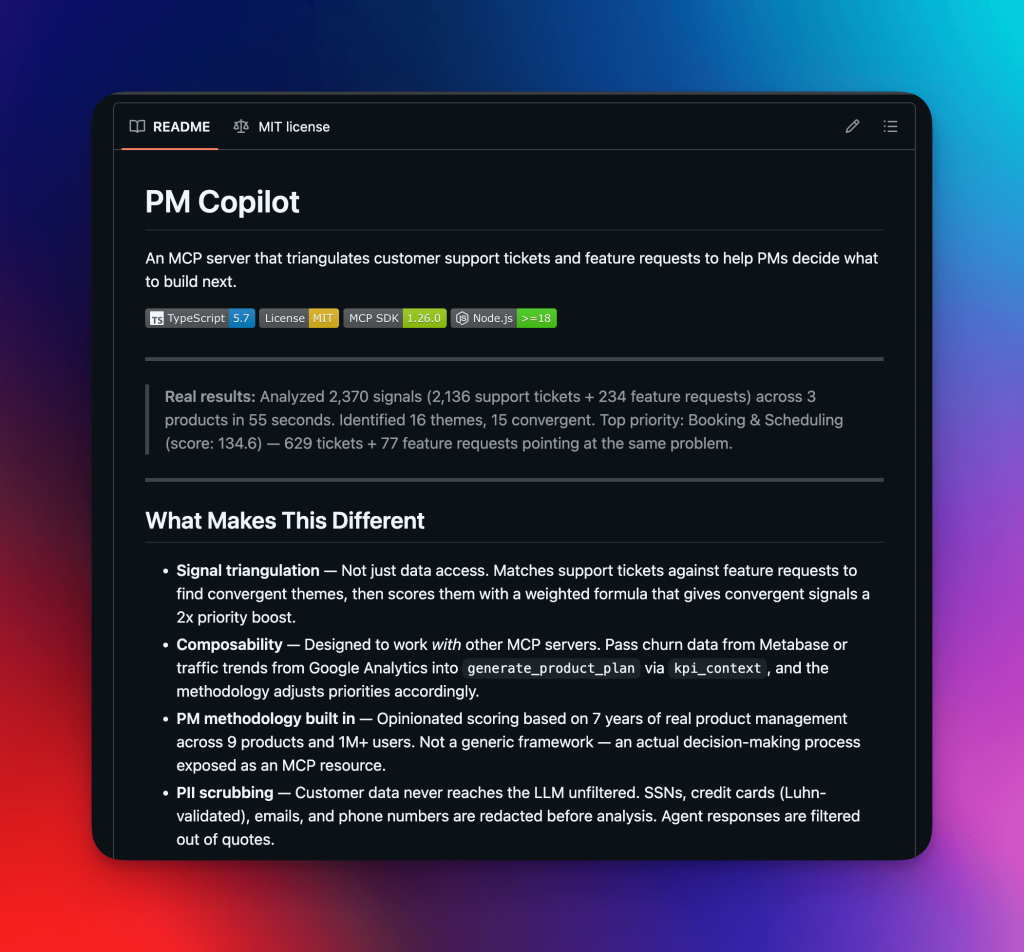
Every month, I get 200+ pieces of customer feedback across three products with over 1M users combined:
- Support tickets in HelpScout
- Feature requests in ProductLift
- Business metrics in Metabase (aka SQL queries)
- Google Analytics data
And every month, I have to turn all of that into a product plan that my team can actually ship.
The core problem is fragmentation. Support tickets tell me what’s broken. Feature request boards tell me what’s wanted. Business metrics tell me what’s declining.
But the highest-confidence signal is when the same theme shows up independently in multiple places — and nobody is connecting those dots automatically.
I’ve been using AI for product planning for over a year (I wrote about my process in another blog post here). But I was still the one manually pulling data from three different tools, pasting it into Google Docs, and asking Claude to synthesize it.
That workflow worked. But it was slow, it wasn’t repeatable, and it didn’t scale.
MCP has changed my approach completely. Instead of me being the glue between data sources and the LLM, I could build a server that handles the extraction, normalization, and scoring. And then let Claude focus on synthesis and judgment. MCP gives structured tool interfaces with typed parameters, composability between independent servers, and a client that orchestrates everything.
This is also where AI-assisted product management is heading.
The next frontier is Claude reasoning about what to build next by looking at customer feedback, bug reports, and business metrics. pm-copilot is my attempt to build that future today.
So I built pm-copilot — an MCP server that triangulates support tickets, feature requests, and business metrics into a single prioritized product plan.