Whenever I think of a new business idea, it starts as a math equation:
Hot industry + people willing to pay = business
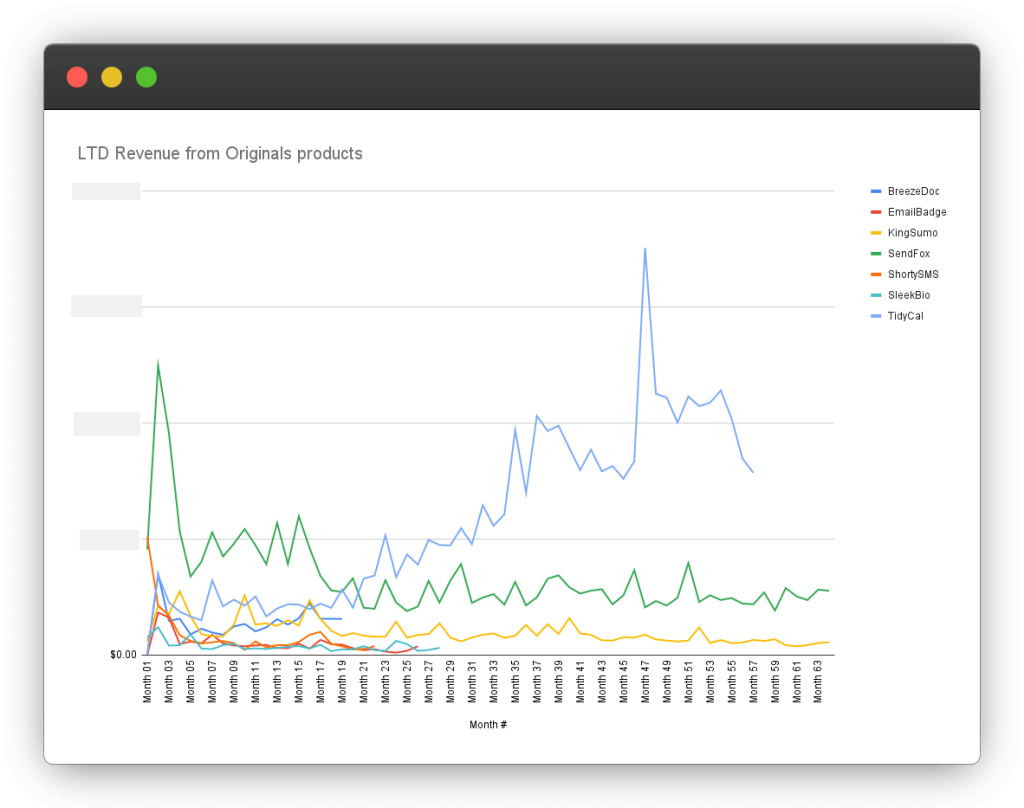
This isn’t the only pathway to a successful business, but it’s one of the cheat codes that I’ve used to grow our AppSumo Originals products from zero to 1M+ users (including three products that have generated over $1M in revenue each).
If there’s a crowded market with a lot of noise, most people see think the signal is to avoid.
But I think the opposite.
Our most popular product ever, TidyCal, came from a realization that a lot of people use calendar tools. And I believed if I could find an angle and get a small percentage of people switch from Calendly and other calendar tools, it could grow into a successful business.
And it worked.
Four years later, with 300K+ users and 5.2M+ events booked and millions in revenue generated, it’s our most successful product ever.
Earlier this year, I took that same mindset into another crowded industry: The job market.
I noticed a lot of people were looking for jobs. I’ve been through long job searches before, and I know how stressful it can be. I wanted to see if I could help people find a job, and eventually turn that into a business.
Here’s the story of how I tried, and failed, to launch ReferCareers.
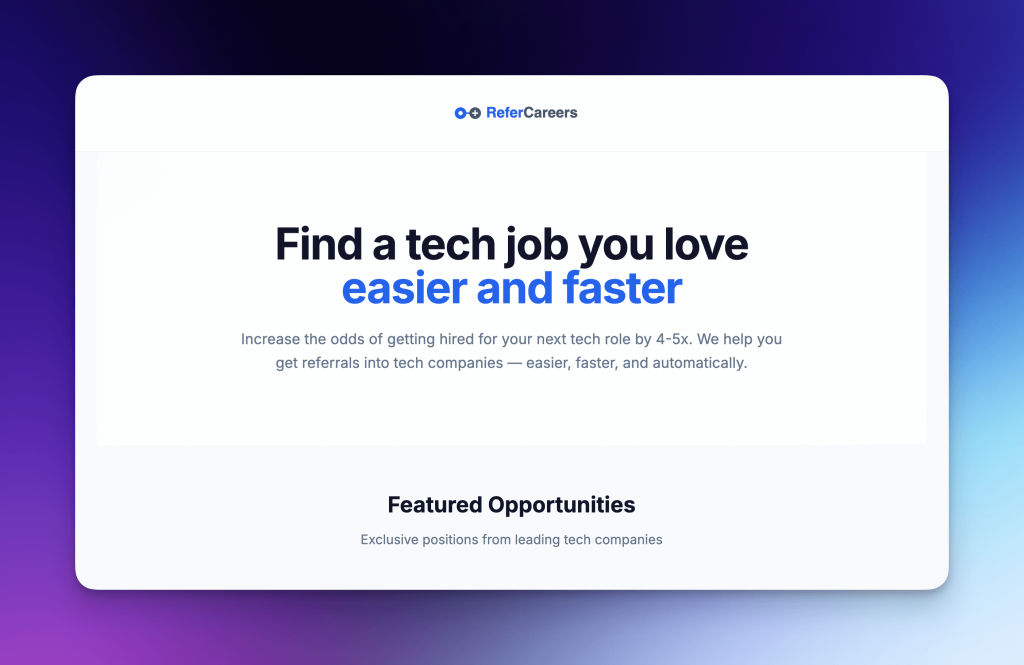
Step #1 – Define the differentiator, and launch the MVP
There are a lot of people looking for jobs, and there’s a lot of advice out there on how to find a job.
But I noticed that most of the job search tips and advice were to work harder, not smarter. Send applications non-stop, grind all day, and hope that it eventually works.
With so many people wanting jobs, I thought there could be a better way.
When thinking about a crowded market, a core question is, “What’s my differentiator?”
In other words, why would someone use your product or service over what they already have?
Why not keep doing what they’re doing?
Why would they switch?
The benefits to switch need to be compelling. Most entrepreneurs forget this, and assume their solution is so magical that everyone will want to just move over. Wrong.
Most people would rather stay with the solution they have, even if it’s not perfect. So a new solution or product has to offer enough benefits to convince people to move over and break through the inertia.
For job searching over the years, I’ve used a different approach than conventional wisdom to land multiple dream jobs: Networking and referrals.
This approach originally started with Ramit Sethi. His advice on finding a job (including his course “Find Your Dream Job“) was foundational in helping me approach job searching different. Since then, I’ve really enjoyed job search advice by by Kareem (of Relentless), Ben (next play newsletter), Alex Rechevskiy, and my friend Chris Ming.
Everyone knows they should network and get referrals to increase their odds of a job, but instead they just click “Easy Apply” on LinkedIn and hope for the best. Eventually they get frustrated and settle, give up, or complain about how the job market is broken.
The opportunity to help people in their job search is from referrals and networking. This was was my differentiator.
To make sure it wasn’t just a “me” success that is not grounded in reality, I did some cursory research using ChatGPT and Claude. And there was data to support, showing that people in tech who got referrals found a job 11% faster and increased their odds of finding a job by 4x.
Thinking ahead to how this idea could turn into a business, I saw three potential paths for revenue. If I could get people using the platform, I could try a few different monetization strategies to see what hit:
- Take a percentage of the referral revenue that a person gets from a successful hire
- Charge people to promote their listings if they really wanted to share a job
- Charge a low monthly fee for the job seekers to get access to listings
This is where most entrepreneurs stop, and it’s a mistake. They just assume that they can have an idea and a few ways to make money, and then, boom, build the product and get the money.
But there are a lot of missing steps in that.
When you define the initial idea and potential monetization on a business, the next step is time to break down the approach into shorter timeframe goals.
You can use a methodology like the SMART framework, OKRs and rocks, or something else. Whatever you choose, define markers of success to stay focused on what matters.
Below are the milestones that I picked that were exciting to me and were indications that I could see being on the right path to eventually a successful full-time business:
2025 Goals
Month 1 – Goal #1 – Get $5,250 from AppSumo referrals (AppSumo had a few open job listings that could promote myself to use my own product)
Month 2 – Goal #2 – Get 5+ other companies to list
Month 3 – Goal #3 – $1,000 in income per team member per month (I was starting this business with my friends Garrett and Henrique)
Q2 – Goal #4 – $2,500 per team member per month
Q3 – Goal #5 – $5,000 per team member per month
Q4 – Goal #6 – $10,000 per team member per month
And once I started laying out the vision for the year, I had ideas on how we could automate if I was getting overwhelmed by the success (the best problem to have, and one I hoped I would):
Ideal automated flow:
- We find companies that pay referral bonuses
- We outreach team members at respective companies to be referrers (till we get 2-3 confirms)
- We scrape and list key (i.e. broad-relevance) remote jobs from relevant companies
- We monitor for applications to the jobs, and do light preliminary requirements matching ?
- If applicant passes, thumbs-up candidate/ask referrer if interested; if applicant fails, decline ?
- If referrer givesl approval, make the intro between both parties ?
- Regular checks on the job listing to see if it’s still active (and remove if not)
Once I had the milestones established, I put together a loose idea of the website MVP.
The focus was to put together the simplest solution that would push towards the goals using the 80/20 (Pareto) principle.
This MVP website flow was done using the simple draw function in a Google Doc. It doesn’t need to be overly complex. Focusing on the core functionality, knowing that I can always iterate over time, is the way to avoid wasting time.
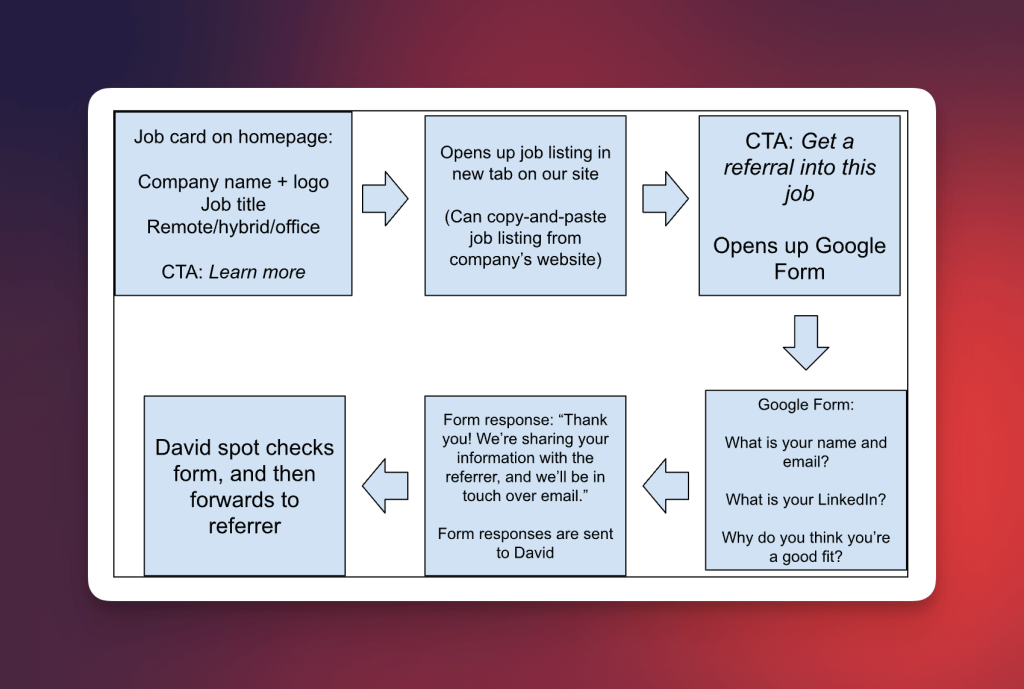
(This idea was launched in February 2025, before Lovable/Replit/Claude Code became so good. If I were to do this now, I would take these simple flow requirements and vibe code a prototype.)
To further detail out the idea, I also wrote a very simple PRD (product requirement document) to fill in the gaps on the end-to-end approach:
- POC/MVP:
- Simple landing page (with no navigation)
- 5 companies with targeted job listings
- AppSumo
- BDM x3 ($1500 each)
- BDA x1 ($750 each)
- Potential companies:
- Procore (Janine – messaged)
- Aerospike (Travis – messaged)
- Google (Jim)
- Salesforce (Jack)
- EA (Tim)
- ZoomInfo
- HubSpot (Scott/David Ly Kim/Alex)
- DocuSign
- Coinbase
- Akamai
- Ideal: Scrape/pull ALL remote jobs from companies that offer universal referral bonuses (Google, Procore, Salesforce)
- AppSumo
- Job seekers check job listings, CTA is to get a referral into job
- Job seekers fill out form, and form is sent to David
- Name + email address
- LinkedIn URL
- Why you want the role
- David then spot checks form and forwards to referrers
- “Hey we have these 15 people who are interested, do you want to refer any?” (and we make intro)
- Outreach to job referrers:
- “Hey NAME – I have a friend who might be interested in a job at COMPANY… do you get referral bonuses? Figure you might as well get paid for the referral if he decides to apply/is hired”
- Marketing:
- David – Job seekers email list
- David – LinkedIn post
- David – Share with J.T./friends I know looking for jobs
- Garrett (?) – Find a way (AI) to scrape layoffs.fyi or people looking for job
- Garrett (?) – Find a way (AI) to find and scrape companies that have referrals
- Future:
- Homepage clarification – “5 step vetting process” for social proof/safety
- AI checks job listing and cross references LinkedIn/short details and gives a grade to referrers for most likely to land job (Potentially use AI Agent)
A lot of product people think PRDs need to be this massive multi-page documents, but PRDs can be really simple. Even the PRD I created for TidyCal, a product that has grown to millions of dollars in revenue, was a bulleted list of 13 features.
In the same Google Doc, I added website copy with a few variations of the headline and then very simple explanation copy:
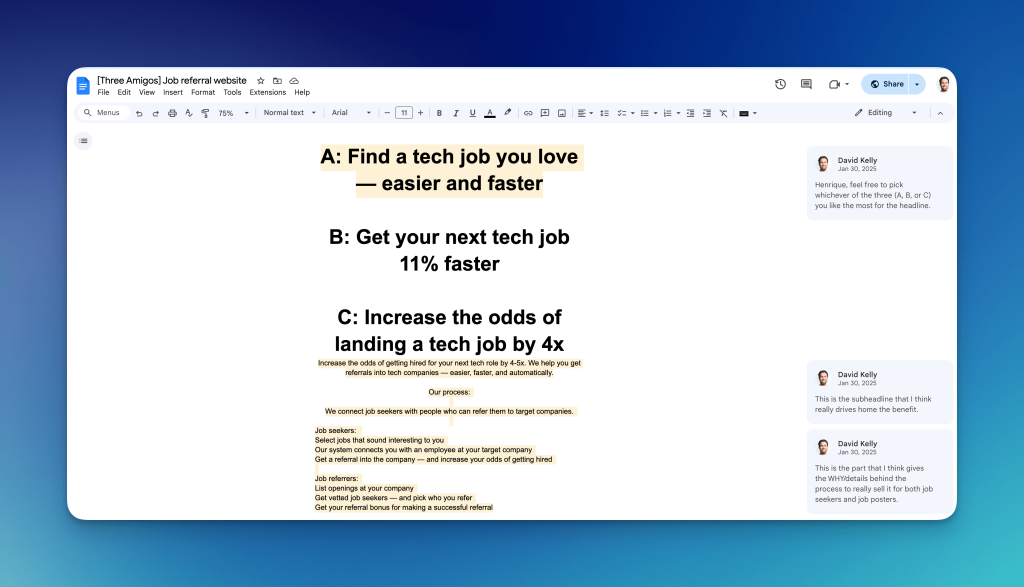
The goal wasn’t to create perfect copy. It was to create benefit-driven, simple copy that got the point across 80% good enough.
If an idea ultimately shows signal, it’s easy to revise and double-down on what’s working. Don’t waste time trying to perfect something before you prove that people use it.
Even the best products I’ve ever created go through constant revisions as the product matures, so you’ll be revising it anyway.
Step #2 – Get the first companies listed
Before I could get job searchers using the website, I had to first get jobs listed on the website.
My preference with launching any new product or business is to be a day one user myself.
When I’m a customer myself, it makes it easier to understand the nuances and make a better experience overall. This is referred to as “dogfooding” in the tech industry, and it’s an approach that Zuckerberg has has talked about extensively for his team at Meta/Facebook.
With dogfooding, we had some roles listed at AppSumo that offered referral bonuses. I listed those on ReferCareers to immediately have job opportunities for job seekers.
But because we only had a few jobs for a singular company, this could also send a red herring signal if people weren’t using. Were they not using because they didn’t find the website/idea compelling? Or because they didn’t care for the roles or for AppSumo as a business?
To test this theory, I wanted to get a few more companies on the site.
Here’s how I found additional MVP companies:
- I searched online for tech companies that offered referral bonuses. After a bit of searching, I found a list of the top 20 companies that have the highest percentage of referred employees.
- I checked my LinkedIn network to see who I knew that worked at those companies.
- I sent an outreach message to people that I knew at these companies first. If I didn’t know anyone at the company, I sent a cold outreach LinkedIn message using slightly modified copy.
- I asked some of my friends directly if the companies they worked for had referral bonuses.
Here’s an example of a message I sent to a connection I had at HubSpot:
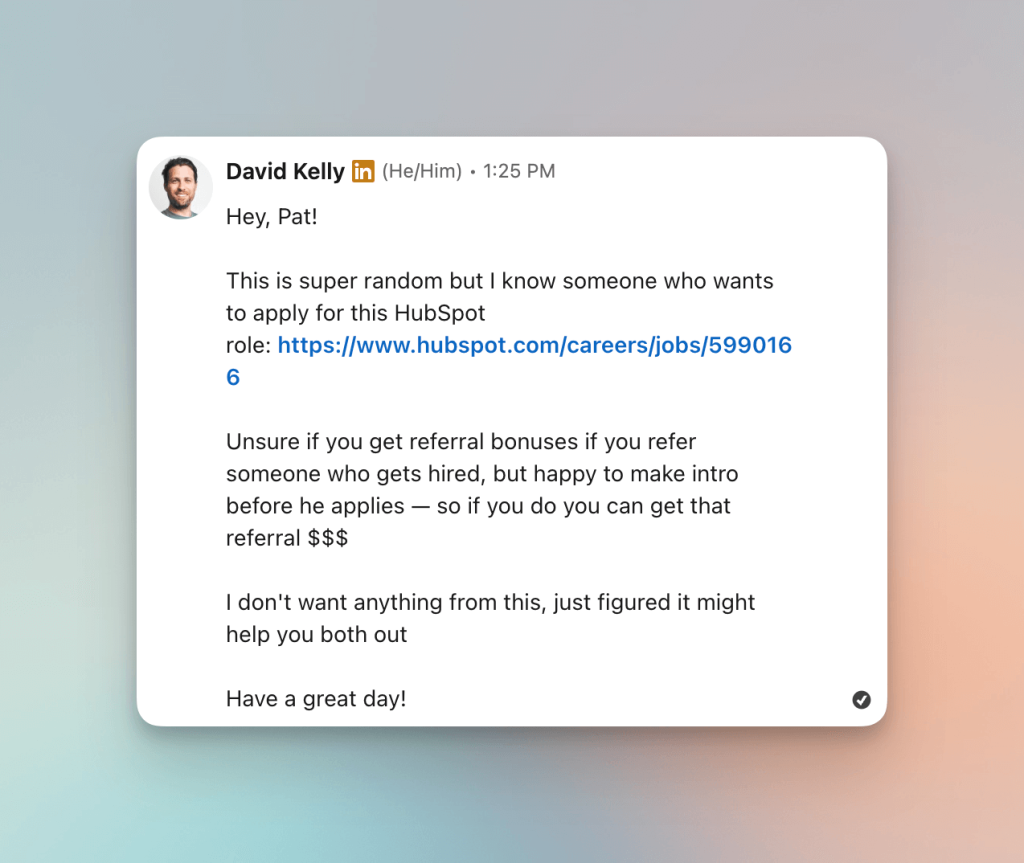
When writing copy, it’s easy to be myopic and focus on yourself. Instead, think about “what’s in it for them?” In this case, why would my HubSpot connection care?
Most business pitches can be broken down into three main hooks: Make more money, save money, or save time. I went with the “make more money” approach for my HubSpot connection.
Once I had 5 companies and 3 roles each, that was enough for me to feel like I could have broad-stroke understanding if ReferCareers had the first signs of promise. I also made sure that the jobs listed on the site were a variety of different types of roles and seniority levels.
Step #3 – Get the first job seekers to try the platform
With a list of 15 roles from 5 companies, the next step was seeing if job seekers were interested in using the website.
To first promote the idea, I went to LinkedIn. I’ve spent the past year building up my LinkedIn presence (posting 1x per week). Here’s the post I wrote to my ~3,000 followers:
After LinkedIn, I moved to email.
During the pandemic hiring boom, I had a lot of friends asking for recommendations on people to hire. I built an email list, using SendFox and LinkedIn, to 80 job seekers.
Dusting off the list for the first time in a couple years, I sent my first email promoting all the different roles that I put up on the site. I focused on a compelling, benefit-driven (a very high salary) to get people to click into the roles. But I didn’t obsess over making the copy perfect:
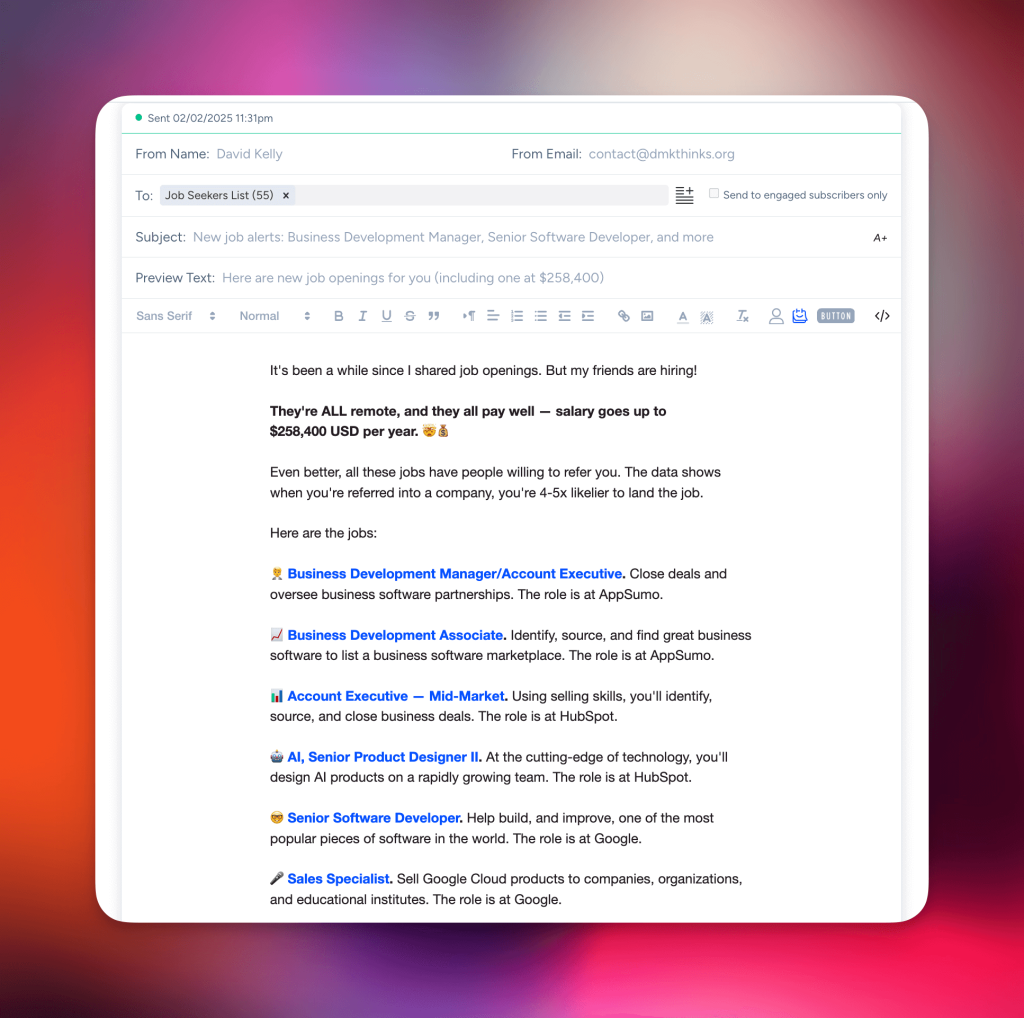
Getting “good” out faster is better than “perfect” that never actually releases. And that was my focus on getting “good enough” copy out there.
Every few days, I’d double-check the job listings to make sure they were still active. If not, I would take them down from ReferCareers and put up new job listings. I would try a lot of different roles, experience levels, and a mix of manager and IC positions.
As a big believer in email marketing (it’s one of the few growth/marketing channels that offers more control), I had us add an email opt-in box to the bottom of the website to capture any visitors who were interested in staying up-to-date on roles. This would be another signal of potential.
This resulted in a flywheel: Post on on LinkedIn ? people come to the website ? even if they didn’t apply, add them to an email list ? send emails to my old job seekers list and this new list promoting jobs ? Hopefully get high-quality applicants
Step #4 – The results, and using failure as a lesson
At AppSumo Originals, 33% of my products (3 out of 9) have generated over $1M in revenue.
On one hand, this is amazing: The industry average is 4%, so the success rate is significantly higher.
On the other hand, 67% of the time we fail. This is a big percentage!
The high chance of failure for even the most successful companies is one of the reasons why I’m a big believer in fast MVPs, fast iteration, and focusing on launching quickly.
When you identify the opportunity, identify the MVP scope, and launch fast, you learn quickly if there’s traction or signal worth continuing, or if it’s a “failed” v1 and you need to iterate or move on.
There could be a lot of reasons for failure, and I’ve experienced them all with our products.
I often talk about our successes of TidyCal, BreezeDoc, SendFox, and KingSumo. But you don’t hear me talk as much about the “failures” of EmailBadge, SleekBio, AppSumo Connect, and more.
Some of the reasons for failing could be:
- Wrong timing. Sometimes the product idea is good, but the market need isn’t there yet.
- Other focuses better worth the time. One of my favorite sayings in business and for startups is “no solutions, only trade-offs”. Some of our products I believe I could have made successful with more time. But this would have meant taking away resources from products that were succeeding already, and slowing down their growth. And that just wasn’t a worthwhile trade-off.
- We realized we just didn’t have strong interest in the product. Adversity is a great signal to measure if we really care about something. If we’re passionate, persistence is easier. Some of our products we realized we weren’t dogfooding ourselves and didn’t care about.
Because of our “move fast” mentality, the silver lining is each of those failures took minimal time. 30-day launch, light continued efforts to see if we could find traction, and the realization that it wasn’t worth our time.
As weird as it may sound, all of these are great. They help free up time, energy, resources, mental bandwidth to move on to bigger and better projects.
And this is what happened with ReferCareers.
As I worked on the site over a couple months, I had three core realizations:
- In a hiring market this tight, the noise was extreme. A lot of people who found our website were low-quality leads from places like Nigeria who were ineligible or radically under-qualified for high-paying U.S. tech jobs.
- None of the candidates we referred across 50+ roles were hired. This was a giant red flag. It was looking like we would need to substantially up the candidate volume or quality, both which take effort and are hard to solve quickly.
- And, most importantly, I realized I didn’t care about this idea that much. My attention was better spent at AppSumo Originals (and, eventually on AI, which I’ve become obsessed learning and experimenting). I just wasn’t as passionate about building a job referral website.
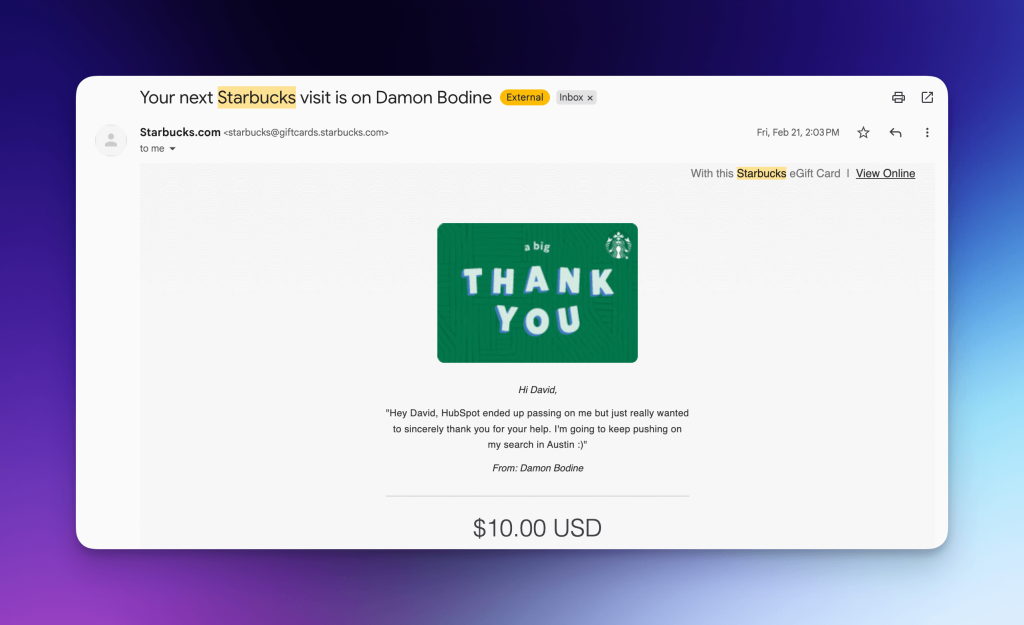
Despite these challenges, there were some nice signs along the way. One candidate sent a Starbucks gift card to me for helping introduce him to a person at HubSpot:
When I think about business in general, I often think of it like a coin flip. You can’t guarantee an outcome, but the more you flip a coin, the higher you can increase your outcome odds.
When you launch fast using a clear scope, clear differentiation, and clear idea
Often, I think about a cautionary tale of a client I helped this year with a business.
This person wanted their new app website to be perfect and didn’t know how to prioritize. They had an approach in mind they didn’t want to change, and it took about three months to build.
At the end of three months, they still didn’t feel good about the website. They wanted a lot more changes. But they had already spent $10,000+ and didn’t have a single client, so they put it on an indefinite pause. This was a costly mistake.
We all fail, but we can accelerate how quickly we learn from our failures and how many times we can flip the coin.
Don’t spend months trying to flip just one coin. Start flipping now.